How to Write a Canadian Mailing Address?
- Aug 23, 2024
- 3 min read
When sending mail within Canada or internationally to Canada, it's crucial to know how to properly format a Canadian mailing address to ensure timely and accurate delivery. The postal system in Canada, run by Canada Post, adheres to specific standards for addressing, which if followed correctly, helps prevent delivery delays, loss, or misdirection of mail. Below is a detailed guide on how to write a Canadian mailing address in different scenarios.

Basic Format of a Canadian Mailing Address
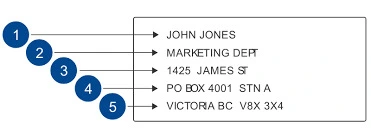
In Canada, the general format for a mailing address is somewhat similar to that of the United States, but with unique elements such as the postal code format. The structure is as follows:
Recipient's Name
Street Address or PO Box Number
City, Province
Postal Code
Country (If Sending Internationally)
Let’s break down each component:
1. Recipient’s Name
The first line should always be the name of the individual or organization receiving the mail. Use full names and ensure they are spelled correctly. Titles such as “Mr.”, “Mrs.”, or “Dr.” are optional, but they can be included if desired. For business mail, the company name can replace or be written under the recipient's personal name.
2. Street Address or PO Box Number
The next line should include the street address or the PO Box number where the recipient receives their mail. In Canada, apartment or suite numbers typically come before the street address. Additionally, ensure to correctly abbreviate terms like "Street" (St), "Boulevard" (Blvd), "Avenue" (Ave), or "Apartment" (Apt). If applicable, this line may also include directional indicators such as "East" or "West."
3. City and Province
On the following line, write the city name, followed by a comma, and then the province abbreviation. Canada’s ten provinces and three territories each have a two-letter abbreviation:
AB - Alberta
BC - British Columbia
MB - Manitoba
NB - New Brunswick
NL - Newfoundland and Labrador
NS - Nova Scotia
NT - Northwest Territories
NU - Nunavut
ON - Ontario
PE - Prince Edward Island
QC - Quebec
SK - Saskatchewan
YT - Yukon
4. Postal Code
The postal code is essential for accurate mail delivery in Canada. It is formatted as a six-character code with alternating letters and numbers, such as “K1A 0B1.” The first three characters represent a "Forward Sortation Area" (FSA) which indicates the geographical region, while the last three characters designate a "Local Delivery Unit" (LDU).
When writing the postal code, ensure that there is a space between the first three and the last three characters, and write the code in uppercase letters.
5. Country
When sending mail from outside Canada, the country name must be added as the last line in the address. Ensure that "Canada" is spelled out completely and written in capital letters to avoid any confusion during international transit.
Tips for Writing a Canadian Mailing Address
While the basic format of a Canadian mailing address is straightforward, some specific guidelines can ensure the accuracy and professionalism of the address. Here are several tips to consider:
Use Clear and Legible Writing
Whether you are writing the address by hand or printing it, clarity is crucial. Ensure that the address is legible and free from errors or smudges. Avoid cursive or overly elaborate fonts that could confuse sorting machines or postal workers.
Avoid Punctuation in Addresses
Canada Post recommends avoiding unnecessary punctuation marks in addresses. Periods, commas, and other punctuation marks should be omitted, except for essential elements like the hyphen separating an apartment number from a street address.
Correct Use of Abbreviations
When using abbreviations, follow the standards set by Canada Post. For example, "Avenue" is abbreviated as "Ave," "Street" becomes "St," and "Boulevard" shortens to "Blvd." The full list of abbreviations is available from Canada Post and should be adhered to for professional consistency.
Use Proper Spacing
Ensure there is a proper amount of space between lines of the address, and especially between the postal code characters (i.e., between the FSA and LDU). Incorrect spacing or missing a space in the postal code could lead to delivery issues.
Double-Check Postal Codes
Postal codes in Canada are critical to delivery. Even minor errors can cause significant delays or loss of mail. Double-check that the postal code provided is accurate. You can verify a postal code by using Canada Post’s online postal code lookup tool if unsure.
Conclusion
Knowing how to write a Canadian mailing address correctly is essential for both personal and professional correspondence. Adhering to the specific format set by Canada Post, including the use of proper abbreviations, capitalization, and postal code formatting, ensures your mail reaches its destination promptly. Whether sending mail within Canada or internationally, following these guidelines can prevent delays and avoid lost or misdirected mail.
SITES WE SUPPORT

Comments